Why honesty matters more than reassurance in 11+ tutoring
Something I have found difficult about 11+ tutoring is being honest when I know that the message is not one a parent wants to hear, and I do not know how they will respond to it.
I started teaching full-time in 2012, spending most of that time in Years 4 and 5. In 2019, I left classroom teaching and set up my tuition business. Earlier this year, I returned to the classroom and now teach a Year 6 class two days a week, alongside private tutoring for the remaining three.
A conversation that shaped my approach
When I was a class teacher, I once had a conversation with the father of a girl I had taught in Year 4. By Year 6, she had received extensive 11+ tutoring but did not gain a place at CCHSG. What upset him most was not the result itself, but something her tutor said afterwards. It was something along the lines of, “She only had an outside chance anyway.”
The issue was not that this assessment was unreasonable. Many children do only have an outside chance, and that is absolutely fine. Some still go on to pass and thrive at grammar school. I have taught a few who have. Or, they get a score that is only just good enough to receive an offer and decide to choose a non-selective school instead.
The real problem was that the family had no idea the tutor felt this way until after the test.
The gap between school performance and the CSSE standard
In Year 4, it was clear to me that this child was working above age-related expectations in most areas, without being exceptional. The CSSE 11+ is a very different standard to day-to-day schoolwork, and tutors often have a clearer sense of what is realistically required to score highly enough for a place. That information should not be revealed after the outcome.
The family felt misled, and understandably so.
Why I chose a different approach
That conversation shaped my approach from day one.
I have always been clear that I will not allow parents to believe their child is doing better than they actually are. Parents are welcome to email at the end of each half-term for an honest progress update. I also make score predictions and share these openly when asked.
These are not optimistic guesses. They are grounded in years of experience with 11+ and CSSE papers, alongside a detailed understanding of how individual children perform across English and maths.
How accurate have my predictions been?
For context:
For the 2026 entry cohort, my final predictions were within 11 marks of the real standardised score on average.
For the 2025 entry cohort, they were within 7 marks on average.
Why small groups make a difference
That accuracy comes partly from experience, but also from working with deliberately small groups. My groups are capped at four pupils. This allows me to see how each child responds when the content becomes harder, how consistent they are over time, and how mindset affects performance under pressure. When you work with children week after week at that level of detail, patterns become very clear.
Large centres often cannot offer that level of individual insight, even when teaching is strong.
Honesty over false hope
Ultimately, I believe honesty matters more than reassurance.
Families deserve clarity early on, even when the message is uncomfortable. That clarity allows parents to make informed decisions, plan sensibly, and avoid false hope at what can be a very stressful time.
The two images attached to this post are real emails I have sent to parents. I have simply used ChatGPT to make them square and to change the names. The first is an email sent earlier this year to a parent of a Year 5 child I currently tutor. The second is a final prediction sent to a different parent ahead of this year’s CSSE 11+ exam.
They reflect the same principle that underpins everything I do: clear, honest communication, grounded in experience, and shared early enough to matter.
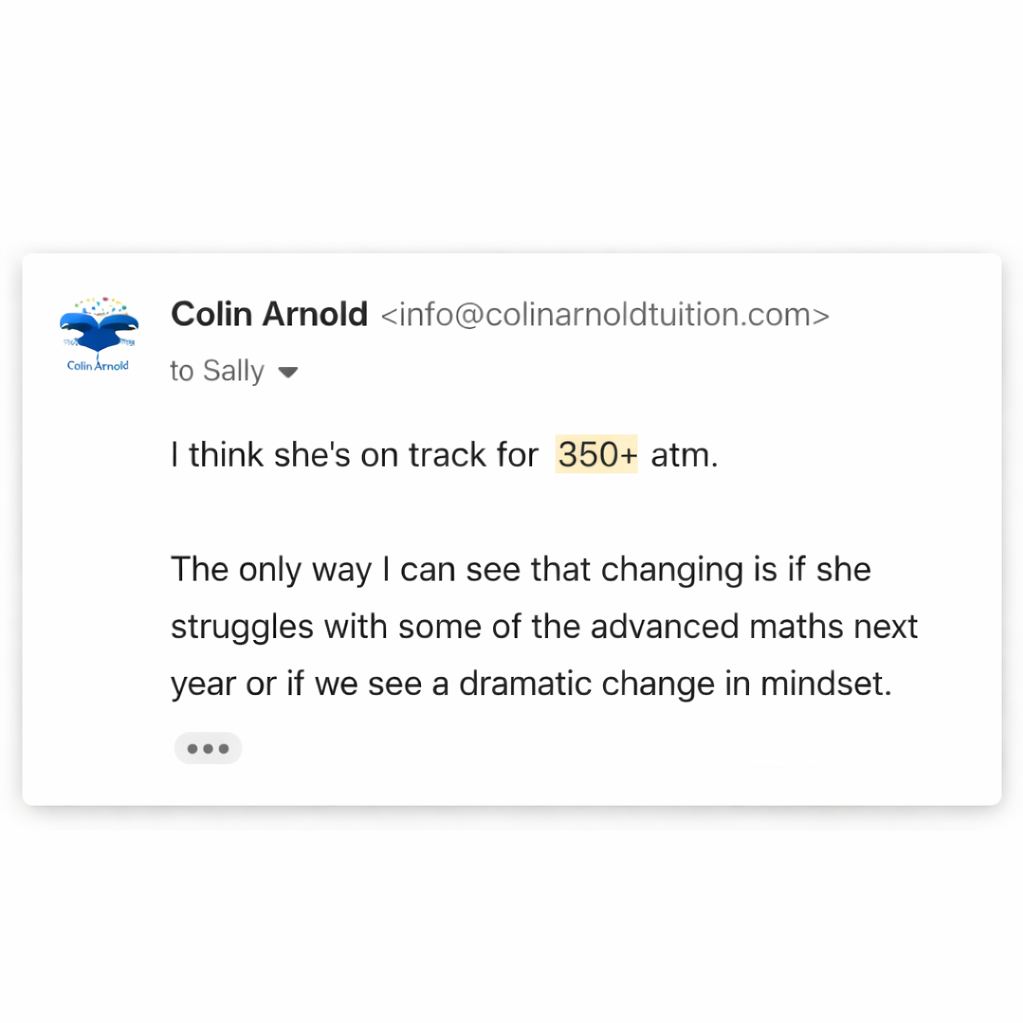
A screenshot of an email showing my written assessment that a pupil is currently on track for a 350+ score, with conditions that could affect this outlook.
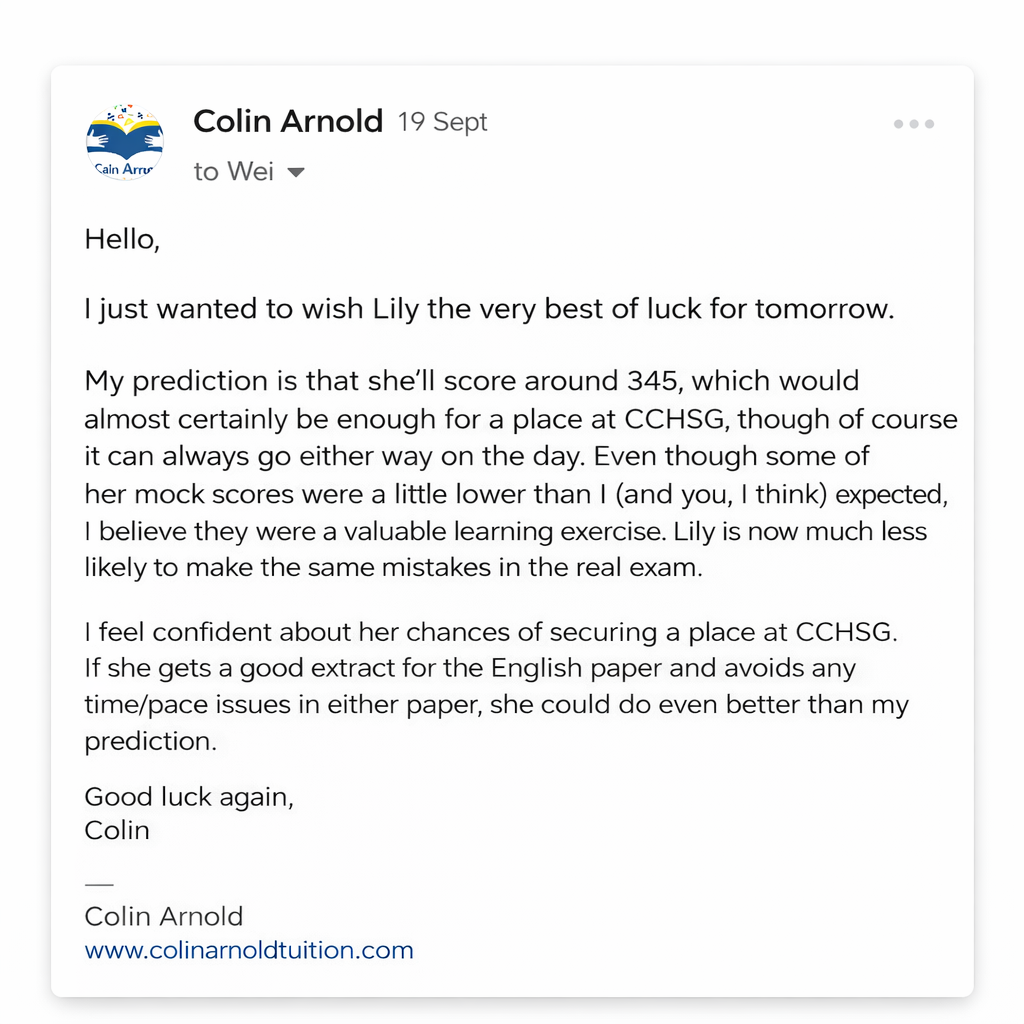
A screenshot of an email sent before the CSSE 11+ exam, outlining my tutor’s predicted score of around 345 and explaining the factors that could influence the final result.
